How to Learn a Language Your Coach Doesn't Speak

You have probably had a teacher who spoke your target language perfectly and still left you quite where you started (I did and many of my students also did before finding me). Correct grammar explanations, clean pronunciation, and a year later you still froze the moment someone asked you a question in a shop.
Hasti came to me for Italian years ago. She got where she wanted to go, and some time later she messaged me to say she had decided to learn German, and asked if we could work together again.
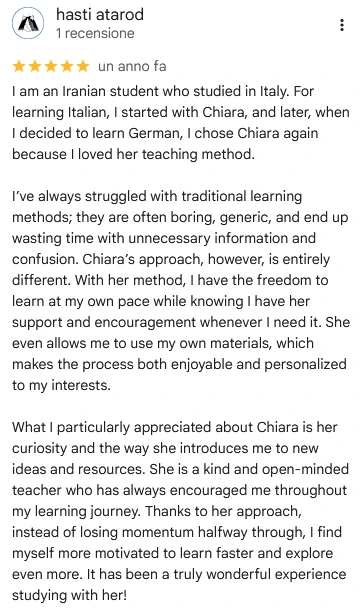
I don't really speak German.
Let's be honest about what that meant in practice. I worked from the basics I still remembered, I checked everything before I sent it, and I leaned on AI to verify what I couldn't verify myself.
I was not her German teacher. I was the person who made sure she practised the right way, a few days a week, from the first week.
It worked. Not because I'm clever, but because the thing that was missing from her previous attempts was never the teacher's German.
Here is what I actually gave her.
1. Speaking spontaneously from day one, not from "when you're ready"
Many methods put spontaneous speaking at the end. So you spend six months preparing to speak and arrive at your first conversation with a head full of rules and no reflexes.
We start on day one, badly, on purpose. Bad speaking on day one becomes usable speaking by week six. Perfect silence on day one becomes perfect silence in month six.
When this works best: when you accept that your first attempts will be ugly. If you can't tolerate sounding stupid for a few weeks, no method will save you.
2. Frequency over intensity
A three-hour lesson on Saturday loses to fifteen minutes every weekday. Your brain files a language as important based on how often it meets it, not how long each meeting lasts.
This is the whole reason my method is called Fluency by Frequency. It isn't a slogan I chose because it sounded good. It's the one variable that separated every language I've learned properly from every language I abandoned.
When this works best: when your life is busy and unpredictable. Frequency survives a chaotic schedule. Intensity doesn't.
3. Use the material you would have consumed anyway
This is the principle Hasti told me changed the most for her, and she put it better than I could. She had spent a lot of time feeling like a bad person for wanting to watch something interesting instead of something useful. One day she practised by shadowing a random video about colour theory, and realised she was allowed to.
(...) it reminded me of you and your method that gave me a permanent tool to remind me that I have free will to practice a language shadowing a random video about color theory instead of feeling a bad person that I'm not listening to a tech-related video
The input that works is the input you'd have opened regardless. A video about colour theory that you actually want to watch will teach you more German than a business podcast you force yourself through and quietly resent.
When this works best: when you've already quit two apps and don't want to be assigned homework by a stranger.
4. The routine has to survive losing your coach
This is the part I care most about, and the part nobody can prove until long after the coaching ends.
Our contact stopped, for reasons that had nothing to do with language learning. Months later she wrote to me, unprompted, to say that when everything around her was pushing her to do the productive thing, she remembered she had a tool that reminded her she had a choice, and she practised by shadowing that colour theory video instead.
A method that only works while you're paying for it isn't a method, it's a subscription.
When this works best: always, and you should demand it from anyone you learn with. Ask them directly: what will I still be able to do on my own after we stop?
So do you need a teacher who speaks your target language?
For accuracy, yes, eventually. For correcting fine nuance, yes.
For getting from stuck to speaking, you need something else: someone who makes sure you open your mouth on day one, show up five days a week, use material you actually like, and walk away with a routine you can run alone.
I brought that to German without speaking German. Hasti brought the German.
If you want the routine, not just the theory: the Frequency Circle is my community for people building exactly this ($23/month, with a one-week free trial). If you want me correcting you personally five days a week, WhatsApp coaching is available as an add-on inside the Circle.