One Voice Message a Day: The 5 Steps That Worked

Negin had been living in Italy for five years.
She had done the classes organised by the municipality (Milan). She had done Duolingo. She could read a bit, she could sort of follow a conversation, like anybody she understood far more than she could produce. And at work, surrounded by Italian colleagues every single day, she still was not speaking.
Less than four months later, she told me she had started talking to them. I had not asked. She just said it, in the middle of a normal exchange, to share her enthousiasm with me.
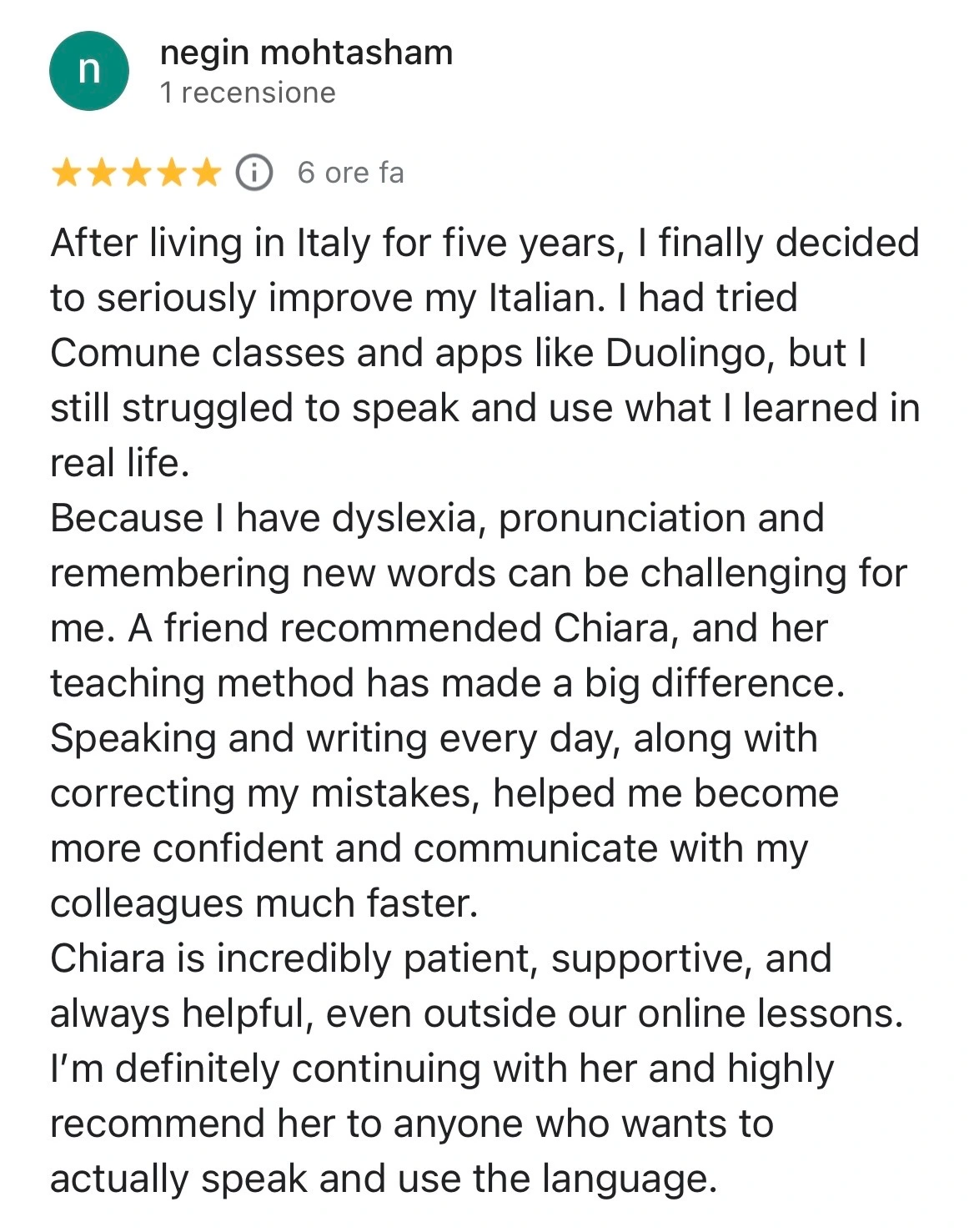
Those five years were not completely wasted, of course she arrived at my door with some basics in comprehension, vocabulary, and grammar, but what she needed was any structure that forced her to produce language on a schedule, with someone correcting what came out.
Here is what we did.
1. She started writing every day, in public
Before any coaching, before any voice message, she joined my community and started posting journal entries there.
Not essays. A few sentences about her day, on a platform where other learners could see them, correcting them through AI first and with my last final check under the post - where I comment and try to spark a conversation with follow-up questions.
When this works: for anyone who already has vocabulary sitting unused. Writing is the cheapest way to find out which words you actually own and which ones you only recognise. My questions give you a chance to express yourself spontaneously every time you publish something online.
2. She showed up for conversation, not for class
She came to the live meetings I was running in the community. Those sessions are conversation, not structured lessons: no syllabus, no unit three, just people talking with someone correcting lightly.
I want to be accurate about this one, because it would be easy to oversell it. Those meetings were not running on a fixed weekly schedule at the time, and she did not attend all of them.
When this works: as low-stakes exposure between the real work. Treat it as maintenance, not as the method.
3. She sent me one voice message a day. One.
This is the step people find hardest to believe.
Not five messages. Not a twenty-minute monologue. One voice message, almost every day, 3-4 days a week.
The volume is deliberately small so that the quality can be high, because the actual work is not in the sending. It is in the repetition and the preparation before she sends it. She would record the same message over and over, reworking it each time, until she had a version worth sending me.
Here is the sequence, exactly:
- Record the message once, without planning it (maybe just a few notes). Whatever comes out, comes out.
- Listen back to your own recording. This part is uncomfortable and it is the point.
- Record it again, fixing what you heard.
- Repeat until it sounds like something you would say out loud to a person.
- Send that version.
If speaking right away is still too difficult, DICTATE INSTEAD OF TYPE (and thank me later).
With time and using always the same bits of sentences because your life repeats, something specific happens: you stop putting the sentence together word by word and gradually start saying chunks of it whole. That is memorisation happening, and those memorised chunks are precisely what you need when a colleague asks you something at the coffee machine and you have two seconds to answer.
When this works: for anyone whose problem is speed rather than knowledge. If you know the grammar and still freeze, this is your step.
4. I corrected it, and I explained it in her language
Every message came back with corrections and, more importantly, with an explanation of why the mistake happened.
I switch languages depending on the topic. With Negin, that means Italian, English, or Persian, whichever gets the explanation into her head fastest. A grammar point explained in a language you are still struggling with is a grammar point you will nod at and forget.
When this works: always.
5. She was texting too
After the voice message, she would keep interacting more in writing between them. Small additions, not a second workload.
When this works: it's often underrated, but of course it's never a replacement for speaking.
Then she stopped for four weeks
This is the part that surprises people who expect coaching to be sold as continuous.
After that first block, Negin took four weeks off WhatsApp entirely. During the break she kept posting on Skool, kept commenting under other people's posts, and kept coming to the live meetings. The intensive work stopped. The contact did not.
Then she came back for another sprint.
I now recommend this pattern to almost everyone, for two reasons:
- Intensive daily correction is genuinely tiring, and people who push through it without a break tend to quit outright rather than pause, and
- the break is where consolidation happens: the corrections from the sprint have to get used somewhere light before they become yours.
It was after the very first block, before the break was even over, that she told me she had started speaking with her colleagues.
What this does and does not prove
She is not perfectly fluent. There is a long way to go and she would tell you so herself.
What changed is that she opens her mouth at work now and her colleagues understand her.
One student is one student.
But there're patterns I see repeatedly:
- daily production,
- real correction,
- an explanation in a language you actually think in,
- and permission to take a month off without falling out of the habit entirely.
If you want to try it
The community is where step one and step two live.
- You post your journal entries,
- other people read them,
- you come to the conversation sessions.
It is the base layer, and it is deliberately cheap.
The WhatsApp coaching is steps three and four, and it works best in sprints: a month on, a month off, with the community holding you in between.