What Level Do You Need to Work With a Language Coach? A Student Asked, Here's My Answer
Can complete beginners work with a language coach? Yes. Here's how my journaling-to-speaking program helps scared beginners build confidence daily
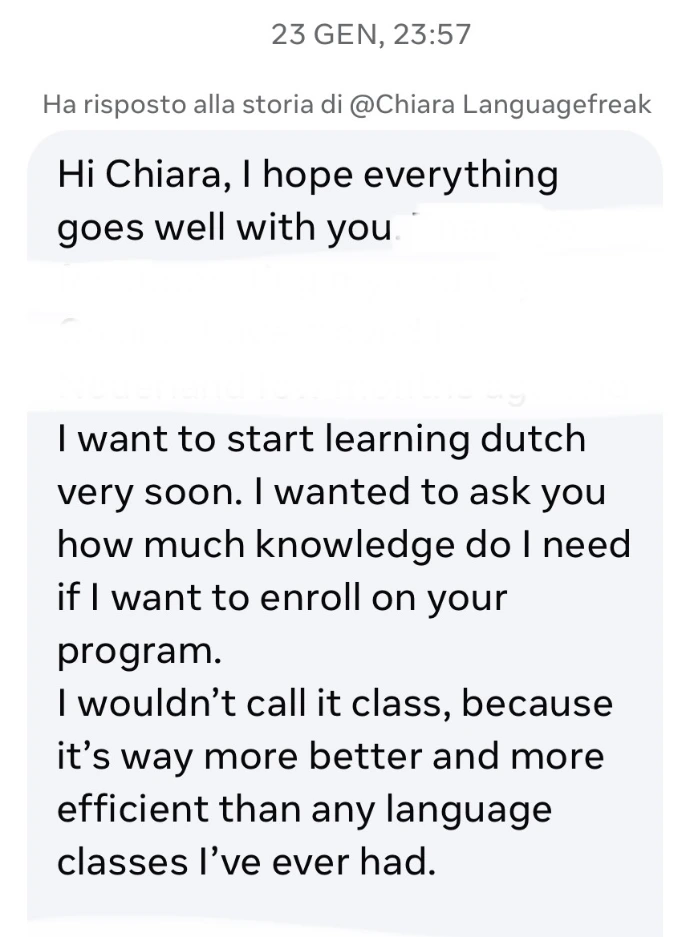
A few days ago, I received this message on Instagram
It was one of the nicest messages I've received. But beyond the kind words, she asked me something important: "What level do I need to work with you?"
I answered her personally, and I also made a video explaining my full answer (you can watch it on my homepage). But I wanted to write this out too - because some things are easier to digest when you can read them at your own pace, highlight what matters to you, and come back to them later.
So here's the complete breakdown of how my program works, who it's for, and why journaling might be the bridge you need between silence and speaking.
The Short Answer: Yes, Complete Beginners Can Start
You can work with me as a complete beginner.
You don't need to be at B1, B2, or any specific level. You don't need to have taken classes for years. You don't even need to know more than a handful of words.
But here's what I also understand: the idea of jumping straight into voice messages when you barely know the language is terrifying. It's overwhelming. For many people, it feels almost traumatic.
And that's exactly why I created the journaling program.
It's a bridge - a gentle, daily pathway from where you are now (maybe you know a few words, maybe you're just starting) to the point where you can actually speak without that fear crushing you.
This Is Not a Class
Let's be very clear about something: if you join the journaling programme, we're not doing traditional language classes.
There are no:
- Grammar drills
- Vocabulary lists to memorize
- Tests or assessments
- Rigid curriculum you have to follow
What we are doing is creating a daily interaction with the language. A way to build your confidence step by step, to make the language part of your daily mental landscape, without throwing you into the deep end before you're ready.
This is guidance, not teaching. Interaction, not instruction.
Why Journaling Works: The Method Explained
It's Not About Perfect Writing
First, let's clear up a misconception: journaling in a language is not about writing perfectly. It's not about flawless grammar or impressive vocabulary.
It's an excuse - an excuse to have an almost daily interaction with the language. To have the language become part of your daily life instead of something you "do" once a week in a class and then forget about.
My Russian Experiment (Winter 2024-2025)
Let me tell you about my own experience, because this is where the method really crystallized for me.
In winter 2024, I did a little experiment with Russian. My Russian was maybe A2 level - not very advanced at all. I could read basic texts, stumble through conversations, but I wasn't fluent by any measure.
Here's what I did: I read and wrote just a few sentences every day about my life. Not about textbook topics. Not about "the weather" or "my family" in the abstract. About real things that mattered to me that day.
Some days it was:
- "Today I did a, b, c, ... I went to d, e, f ..."
- "I watched a Russian video and understood a, b, c, ... without subtitles."
- "I listened to the song (x) and I try to translate it"
Just a few sentences. Nothing fancy.
The Progression That Changed Everything
And I saw what I can only describe as a little miracle (because when I went back to Brussels I was able of chatting 2 hours with my Russian-speaking friend, something that had never happened to me and he even asked me multiple times "What happened in Italy? Were you always with Russians?"... not at all haha).
Week 1-2: I would write my sentences, struggling to find words, looking things up constantly.
Week 3-4: For every entry I wrote, I started reading it aloud afterward. Just to hear how it sounded.
Week 5-6: Then something shifted. I started auto-dictating what I was going to write. Instead of thinking in English and translating, I would say the Russian sentence out loud, little by little, word by word, and then write down what I had just said.
Do you see what happened there?
I was connecting my brain to my mouth, not to my pen.
My hand wasn't the intermediary anymore. My voice was.
Week 7-8: By the end, I was speaking short thoughts in Russian throughout my day, even when I wasn't journaling. The language had moved from "something I write" to "something I think and speak".
And that's when everything changed. Because speaking isn't about writing perfectly - it's about getting your brain and your mouth to work together in that language, in a timely manner, without panic.
The Versatility of This Approach
Here's the beautiful thing: journaling is extremely versatile. You can adapt it completely to your interests, your schedule, your learning style.
What "Journaling" Can Actually Look Like
You don't have to write a diary entry every single day. Some days, yes, I would journal about my life. But other days:
- I would note down words I found while watching a Russian YouTube video
- I would translate a song I liked, line by line
- I would do a simple grammar exercise from a textbook and write my own example sentences
- I would write questions I wanted to ask my Russian-speaking friend later
A real example from someone I'm working with now:
He's learning Italian. When there are too many words he doesn't know from my responses, he simply sends me an entry where he takes notes about the expressions he encountered. He writes:
"'dare per scontato' = 'to take for granted.' Example: Non dare per scontato il tempo che hai. (Don't take for granted the time you have.)"
He's basically using our interaction as his study material. And it works beautifully because he's engaging with real language he actually encountered, not textbook examples about fruit or train stations.
Adapt It to You
The method adapts to:
- Your interests (sports, cooking, politics, art—whatever you care about)
- Your schedule (3 sentences or 3 paragraphs)
- Your level (complete beginner or intermediate plateau-breaker)
- Your goals (conversational fluency or professional proficiency)
The only requirement is consistency. Show up. Engage. Even if it's just a little bit.
Why Accountability Changes Everything
When I did my Russian experiment, what really made the difference was being in an accountability group. I was sending my entry every single day to people who could actually read it and interact with it.
Not an app. Not an algorithm. Real humans who cared about my progress.
And that's where I come in for you.
The Human Element
I can read what you write. I can interact. I understand what you're saying, what you're trying to express, where you're getting stuck.
I can give you guidance when you need it. I can correct mistakes that AI might miss (or that AI might over-correct, losing your natural voice in the process).
This is not automated. This is not a bot sending you templated responses. This is a daily human interaction with someone who understands your language journey because I've walked it myself in multiple languages.
How It Actually Works: The Daily Program Breakdown
Let me break this down very clearly so you know exactly what you're getting.
✅ Daily interaction:
- I send a check-in message at 11 PM
- You send your sample (writing, notes, optional audio)
- I respond with guidance, encouragement, direction
✅ Flexible prompts:
- My reactions can work as optional prompts when you've run out of ideas
- You're never stuck wondering "what should I write today?"
✅ Ongoing conversation:
- You don't need to write "Hello, how are you?" every day
- It's not formal
- It's just ongoing, like the language is part of your daily mental world
✅ Human guidance:
- Not AI slop in response to your entries
- Not grammar red-pen markups
- Real feedback from someone who gets it
What This Is NOT
❌ Grammar corrections:
- I'm not going to sit there with a red pen marking every mistake
- That would take too much time and make the program expensive
- The journaling program is intentionally very affordable because it's about guidance, not grammar drills
❌ Formal lessons:
- No structured curriculum
- No "today we learn the past tense"
- No tests or homework assignments
❌ Pressure to be perfect:
- Make mistakes
- Sound awkward
- Use Google Translate if you need to
- The point is engagement, not perfection
What Happens Over Time
And you know what happens when you do that? When you eventually want to switch to voice messages, it's not traumatic anymore.
Because you're already accustomed to expressing yourself. The language isn't this foreign, scary thing anymore. It's just part of your day.
Your brain has been forming thoughts in this language daily. Your eyes have been reading it. Your hand has been writing it. Your voice (if you've been reading aloud) has been saying it.
By the time you're ready for real-time conversation, it's not a leap. It's a step.
The Three Phases of the Journey
Here's the path I'm offering you:
Phase 1: Journaling Foundation
- You start with journaling
- Get comfortable expressing yourself in writing
- Build that daily habit
- Connect your brain to the language
- Goal: Consistency and comfort with written expression
Phase 2: Voice Integration
- Read your entries aloud
- Start auto-dictating before writing
- Send optional voice notes
- Connect your brain to your mouth
- Goal: Bridge the gap between writing and speaking
Phase 3: Speaking Practice
- Transition to voice messages when you're ready
- Continue with written support as needed
- Build conversational confidence
- Goal: Real-time expression without fear
And by Phase 3, it won't feel like jumping off a cliff. It'll feel like the next natural step.
Because you've been building confidence this whole time. You've been active. You've been engaging. You've been making the language yours.
Why This Works (The Science Behind It)
Let me briefly explain why this method is effective from a learning perspective:
1. Spaced Repetition Through Daily Practice
Instead of cramming once a week, you're touching the language every single day. Your brain gets repeated exposure in short bursts, which is exactly what aids long-term retention.
2. Low-Stakes Practice Reduces Anxiety
There's no audience. No judgment. No "getting it wrong in front of the class." Just you, the page, and gentle guidance. This lowers your affective filter—the emotional barrier that blocks language learning when we're anxious.
3. Brain-to-Mouth Connection Formation
When you read aloud and auto-dictate, you're literally training your brain to coordinate with your mouth in the target language. This is the same neural pathway you'll use in conversation, but you're building it in a safe, controlled environment first.
4. Personalized, Relevant Content
You're writing about your life, your interests, your questions. This makes the language immediately relevant and memorable. You're not memorizing "The pen of my aunt" from a textbook—you're learning how to express what actually matters to you.
Common Questions
Q: What if I make a lot of mistakes?
A: That's completely fine and expected. I won't overwhelm you with corrections. The goal is communication, not perfection.
Q: What if I miss a day?
A: Life happens. Just pick up the next day. This isn't school - there's no punishment for missing a day. The habit is more important than perfect consistency.
Q: Can I use AI tools like ChatGPT to help me write?
A: Yes, but try writing first, then use AI to check or improve. The effort you put in is what creates the learning.
Q: How long until I can speak?
A: It varies by person, but most people feel ready to try voice messages within 4-8 weeks. Some sooner, some later. We move at your pace.
Q: What languages do you offer this for?
A: Italian, English, French, and Dutch.
Q: Is this suitable for intermediate learners too?
A: Absolutely. If you're at an intermediate level but still afraid to speak, or if you've plateaued, this method can help you break through. We just adjust the complexity of what you're working on.
How to Start Tomorrow (Even Without Me)
Want to try this approach on your own first? Here's how to start:
Step 1: Choose a simple format
- Write 3 sentences about your day in your target language
- Or: Note down 5 new words you encountered
- Or: Translate one verse of a song you like
Step 2: Write it out
- Use a notebook, a notes app, whatever works
- Don't worry about mistakes
- Look up words you don't know
Step 3: Read it aloud
- Hear yourself saying the words
- Notice how it feels in your mouth
- Stumble through it—that's fine
Step 4: Note one thing you want to improve tomorrow
- A word you want to use correctly
- A grammar pattern you want to practice
- A phrase you want to learn
Step 5: Repeat tomorrow
- Keep the streak going
- Even if it's just two sentences
- Show up
Then Decide
Try this for a week. See how it feels. Notice what happens.
Then decide: Do you want accountability and guidance while you do this? Do you want someone to interact with, to give you direction, to keep you going?
That's where I come in.
Next Steps
If You Want to Try This Approach With Guidance
I offer this journaling-to-speaking program for Italian, English, French, and Dutch.
Contact me here to get started.
The program is intentionally affordable because I want it to be accessible. And because the format - daily check-ins, short responses - allows me to work with people sustainably.
Want More Resources?
Read my Substack article on journaling techniques for more detailed examples and variations you can try.
You don't need to be at any particular level to start working with me. You don't need to have it all figured out. You don't need to wait until you're "ready."
You just need to be willing to show up, even just for a few minutes a day.
The path is there. From silence to writing. From writing to reading aloud. From reading aloud to speaking.
And you don't have to walk it alone.
The question isn't "Am I good enough to start?"
The question is "Am I willing to try?"
If the answer is yes, I'm here.