Why People Don't Understand Your Dutch Even When Your Grammar Is Correct
A rhythm exercise you can do on a table, borrowed from music class.

Back in March, my boyfriend was reading a Dutch sentence out loud to me and it was going badly.
He knew the words. He could have written that sentence himself, correctly, with the right spelling and the right grammar. Out loud, he was running Italian intonation and Italian sound patterns over Dutch words. A sentence that was perfectly correct on paper turned into something a Dutch speaker had to work to decode.
If you study your vocabulary, get your grammar clean, then open your mouth and people still say "sorry?", this page is for you.
He put it better than I could when I asked him about it:
"You can have the best vocabulary in the world, but if you don't go with a certain cadence, you're incomprehensible."
That's why, in the class we had together, I started beating time on the table.
The problem is length, not sounds
Most pronunciation advice goes after individual sounds. The Dutch g. The French r. The Italian gli. Those matter, and they are also the slowest thing to change.
Syllable length is faster to change and it does more work. In a lot of languages, how long you hold a syllable carries meaning, and getting it wrong doesn't produce an accent. It produces a different word, or no word at all.
- man (man) and maan (moon)
- bot (bone, or blunt) and boot (boat)
- zon (sun) and zoon (son)
- tak (branch) and taak (task)
These pairs differ in vowel quality too, so length isn't the only thing separating them. But length is the part a learner can control on purpose and immediately.
Italian does the same thing with consonants:
- pala (shovel) and palla (ball)
- note (notes) and notte (night)
- sete (thirst) and sette (seven)
- casa (house) and cassa (crate, or checkout)
The written double letter is a duration instruction. Hold the consonant. Italians who hear you skip it don't hear a small mistake, they hear the other word and then have to reverse out of it.
This runs in both directions, by the way. Flemish speakers learning Italian often miss the same distinction, and I struggle to understand them when they do. Pellicce (fur coats) and felice (happy) are close to identical on paper if you ignore length:
- pel-lic-ce: short, short and stressed, short
- fe-li-ce: longer, long and stressed, short
Why the hand and not the ear
He's a musician in his free time. Self-taught, never took a course in his life, but he plays.
I reached for this assuming he'd have a vague idea of what I was about to do, and I was wrong: he had never done solfège at all. I had, because I'm a slightly less freestyle player than he is. So I ended up teaching him something.
Musicians who learn with a structure don't only learn rhythm only by listening. They learn it by moving too. Hand down on the beat, hand up on the offbeat, over and over.
My theory is that an untrained ear can't hold a sound still long enough to compare it to the next one. The sound is gone before you can measure it. Your hand can hold it. The hand turns a length you can't catch into a distance you can see.
That's a theory built on one learner and one language. The technique itself is the part I've watched work.
The technique, step by step
You need one hand, a table, and one sentence.
1. Pick a sentence you can already read. Not a hard one. The point is to feel it rather than decode it. Ours was:
Ik ga frietjes halen (I'm going to get fries)
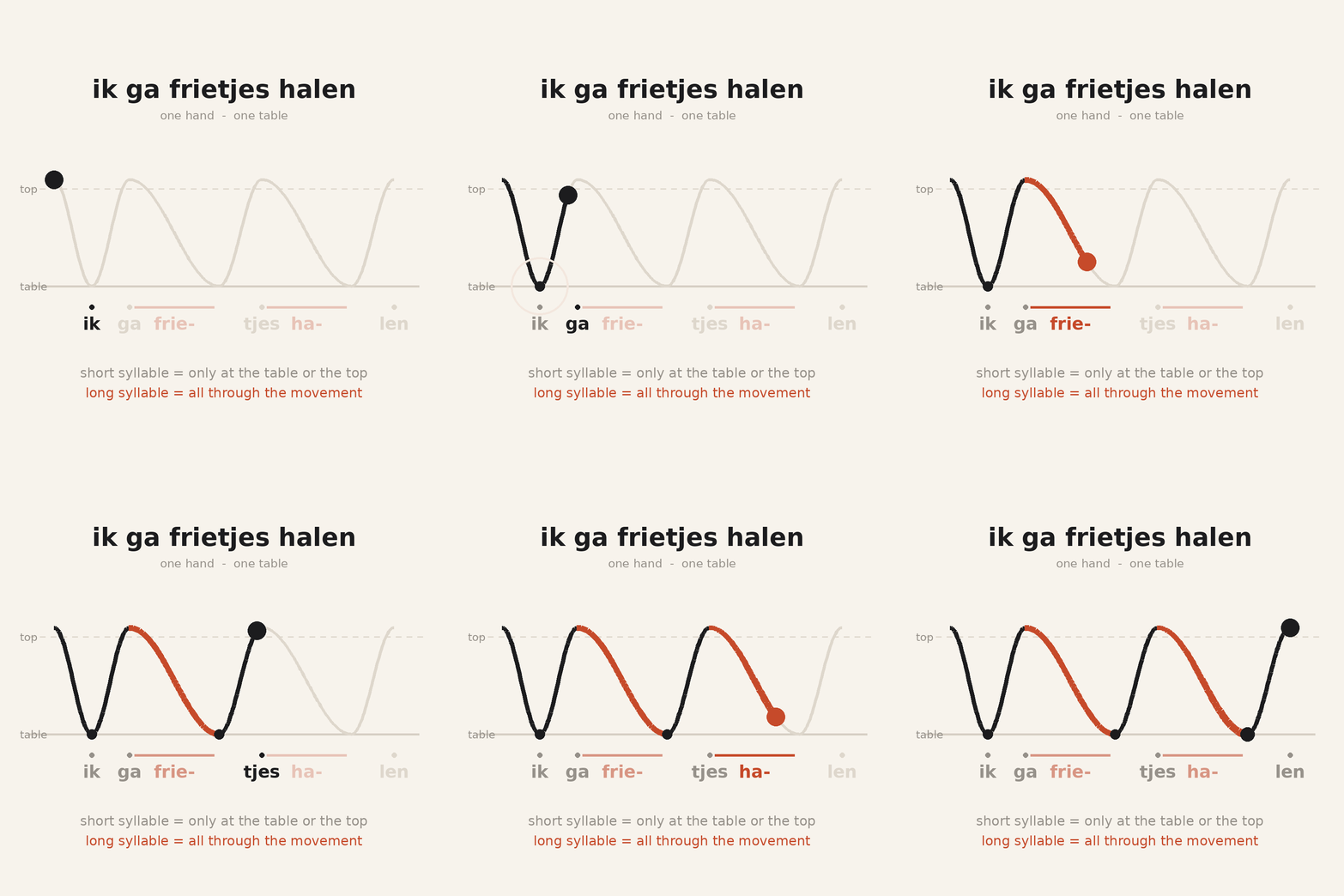
2. Split it into syllables and tap one per syllable. Hand comes down, touches the table, comes back up to the top. That full down-and-up is one syllable. Go slowly and stupidly at first.
ik / ga / frie / tjes / ha / len
3. Find the long ones. In every language with a length distinction, some syllables stretch and some don't. In our sentence, frie and the ha in halen stretch.
4. Give the long syllable the whole movement. This is the entire trick. A short syllable is a point: you say it at the moment your hand touches the table, or at the top of the arc, and it's over. A long syllable is a distance: you start it as your hand leaves the table and you're still saying it when your hand reaches the top, or the other way round.
ik (tap) / ga (tap) / friee (whole movement) / tjes (tap) / haaaa (whole movement) / len (tap)
5. Say the sentence at normal speed with your hand still moving. Smaller movements, faster, same proportions. The long syllable still gets more distance than the short ones. That proportion is the thing you're actually learning.
Do this with five sentences and you'll start doing it in your head without the hand.
What to tap in each language
The exercise is the same everywhere. What you're marking with it changes.
Dutch. Mark the long vowels. Written double vowels (aa, ee, oo, uu) and vowels in open syllables get the whole movement. Single vowels closed off by a consonant get the tap. This is the highest-payoff version of the exercise, because Dutch punishes a missed length distinction immediately.
Italian. Mark the double consonants and the stressed vowel. In notte, the movement belongs to the tt, and you should feel yourself holding your tongue against the roof of your mouth for the length of the arc. In note, the stressed o takes the movement instead and the t is a tap.
French. French doesn't hand out length syllable by syllable in the same way. What it does is stretch the last syllable of each rhythmic group, and give the syllables before it roughly equal, even weight. So tap evenly through the group and save the whole movement for the final syllable: je vou-drais un ca-fé. Italian and English speakers usually make the opposite mistake, scattering stress across the middle of the phrase.
I'll add one caveat, since I teach French in Brussels: Belgian French keeps some vowel-length contrasts that many Parisian speakers have merged. If you're learning here, your ear is being trained on the Belgian version, and that's worth knowing rather than worrying about.
English. Invert the exercise. English shortens and swallows unstressed syllables, so the useful work is making the short ones shorter rather than the long ones longer. In comfortable, the whole movement goes to com and everything after it gets one hurried tap. Learners who give every syllable equal weight sound careful and clear on paper and hard to follow in a meeting.
A note for musicians
I mean solfège in the Italian sense: beating time while you say the notes, down on the battere, up on the levare. It's purely about how long a thing lasts.
When it goes wrong
Your hand speeds up to match your mouth. The hand is supposed to be the metronome. Slow the hand down first, then let the sentence follow it.
You tap per word instead of per syllable. One tap per syllable, including the ugly unstressed ones you'd rather rush past.
You can't tell which syllable is long. In Dutch and Italian, the spelling tells you most of the time: double vowel, open syllable, double consonant. Read the rule off the page rather than trying to hear it. Hearing it comes later.
The sentence sounds robotic. It should, for the first few minutes. The exaggeration is temporary and the proportion is what stays.
It feels counterintuitive on certain sentences. He said this too, and I'm keeping it in: "On some sentences, solfège is very counterintuitive for me." Set the base with easy sentences and let the awkward ones wait.
What this fixed, and what it didn't
His accent did not improve. He'll tell you so himself:
"I don't think solfège can improve the pronunciation of a single word. In fact I'm still pronouncing them not perfectly. But it evidently makes other people understand you."
Individual sounds stayed roughly where they were. What changed is that when I play his voice messages to a semi-native friend of mine, that friend now understands him.
He also didn't believe me at first. He justified himself like this:
"At a subconscious level it was unacceptable. You think: I can write well, so I must speak well too. And no."
"It was funny, because I couldn't accept that there could be rules that simple. And that if you break them or ignore them, you don't get understood."
He still makes mistakes on individual sounds. They disappear inside the music of a sentence that's understandable.
Where to practise it
Use sentences you've already written yourself. Something you wrote in a journal entry, or a message you sent this week, or a sentence you got corrected on. Sentences from a textbook work, and sentences you produced yourself work better, because you already know what you meant by them and your attention is free for the rhythm.
Take one sentence in the language you're learning. Tap it out. Find the syllable that stretches, give it the whole movement, and read the sentence back.
Then tell me what happened, especially if you have zero musical background. My evidence here is one learner and one language, and he happened to have an ear that isn't naturally good but is at least trained. I'd like to know whether this holds for people whose ear isn't.
Questions people ask about this
Do I need to be able to read music? No. The exercise uses one hand and a flat surface. Reading music helps you name what you're doing and changes nothing about the doing.
Does this work for tonal languages? I don't know. Everything above is about duration, and tonal languages carry meaning in pitch as well. I haven't tested it on one and I'm not going to claim it transfers.
Will this fix my accent? No. It changes how easily people follow you, which is a different thing, and in my experience a more urgent one.
How long before it works? He noticed a change over a few weeks of doing it inside our regular sessions. I can't give you a number that would mean anything, because I've watched this with one person.
Can I do this alone? Yes, for the tapping. You'll need someone to tell you whether the result is actually more understandable, since that's the one thing you can't judge from inside your own mouth.